React to LLM JSON as It Streams, Not After It Lands
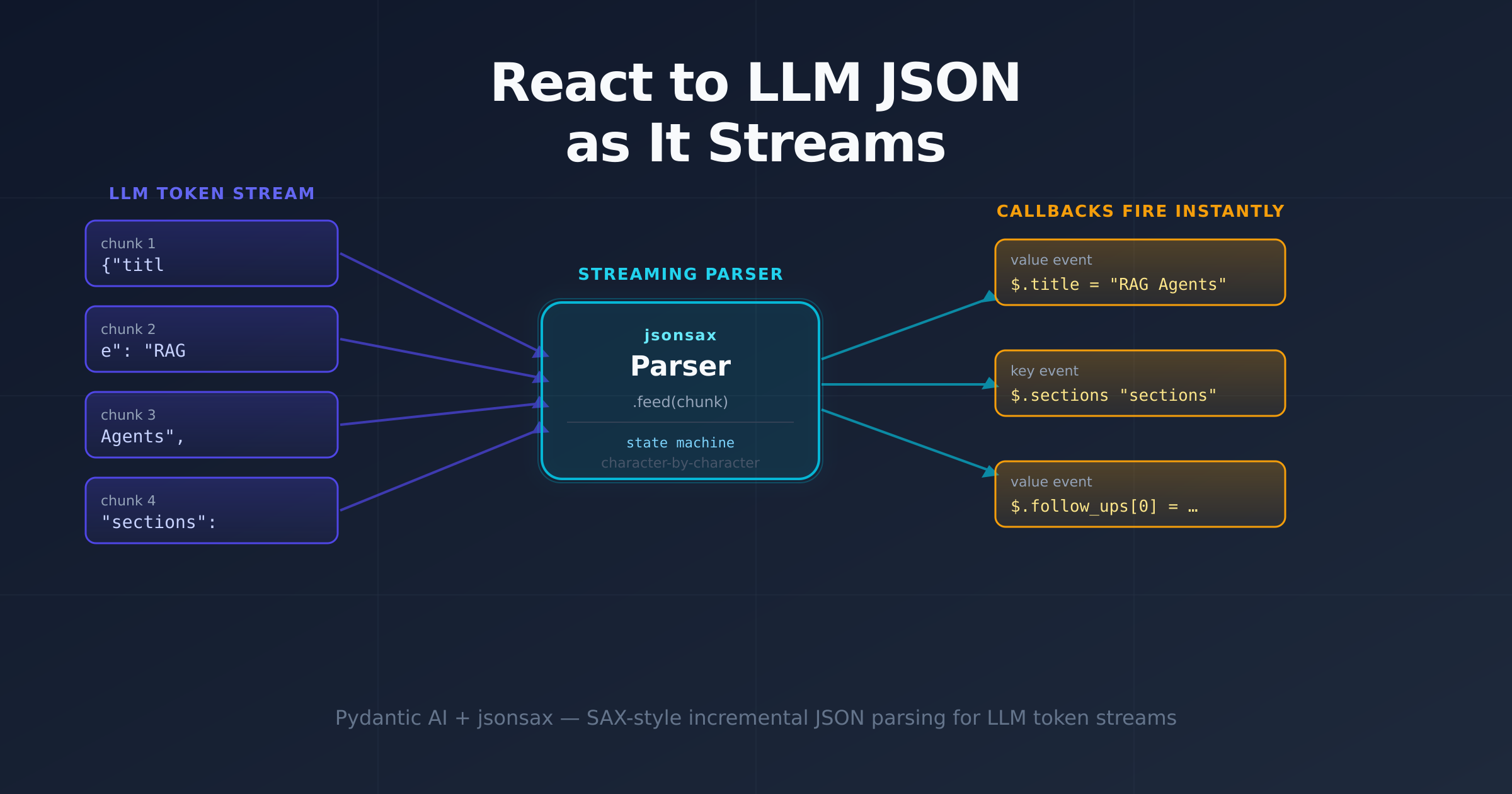
When you ask an LLM to respond with structured JSON, the usual pattern is: wait for the whole response, then parse it. That works — but it throws away everything streaming gives you. If the model is generating a 2,000-word article, you're sitting on your hands until the last } arrives before you can show anything.
This PR wires a SAX-style streaming JSON parser (jsonsax) into a Pydantic AI agent so that fields print the moment they finish arriving — the title appears before the first section has started, and each section renders as it completes.
The problem
Pydantic AI's run_stream() with output_type=SomeModel buffers partial structured output and yields increasingly complete snapshots via stream_output(). That's great for observing progress, but you still can't act on a field until the model has written enough of the document for the partial object to be valid. In practice, $.title isn't available until the Pydantic model's required fields all have values — which means waiting for the end.
The stream_text(delta=True) API gives us raw token deltas instead. That's the hook we need: raw text arrives in small pieces, and we can feed it into a streaming parser that fires a callback the moment it finishes any JSON value.
The approach
The core idea is a SAX-style JSON parser: instead of building a tree, it fires events (callbacks) for each structural element as it's recognized. This is exactly how XML SAX parsers have worked since the 1990s — same idea, different format.
jsonsax is a dependency-free Python library built for this. You feed it text in arbitrary chunks, and it calls your registered handlers:
from jsonsax import Parser

parser = Parser()
parser.on("value", lambda path, val: print(path, "=", val))

for chunk in ['{"titl', 'e": "RAG"', ', "score": 9}']:
    parser.feed(chunk)
parser.close()
# $.title = RAG       ← fires as soon as the string closes
# $.score = 9
The alternative would be to try to incrementally deserialize Pydantic models from partial JSON ourselves — brittle, schema-dependent, and reinventing a parser. Using a dedicated streaming parser and keeping the Pydantic model for final validation is a cleaner separation.
Implementation
ArticleStreamPrinter
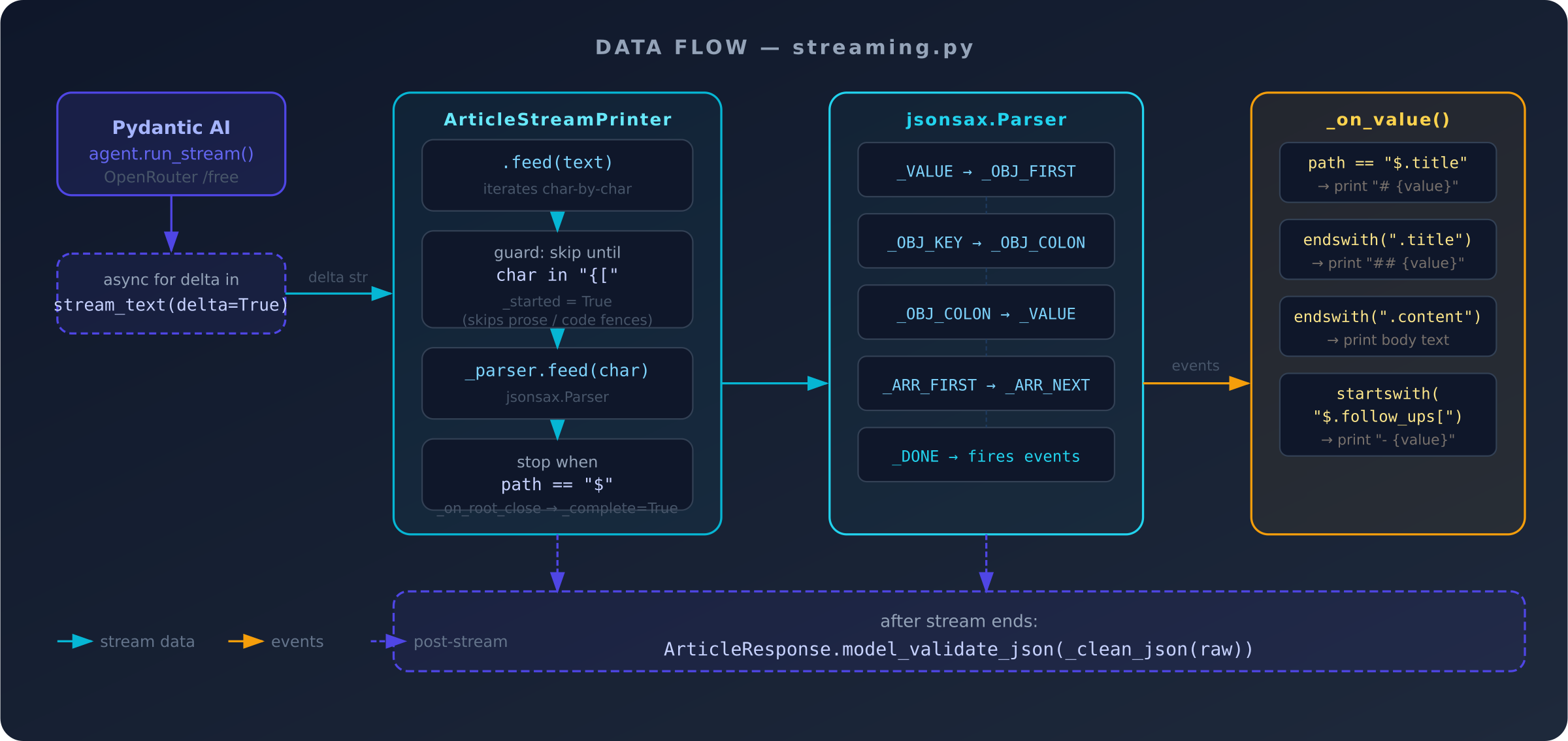
The main new class in streaming.py. It wraps a jsonsax.Parser and has two responsibilities: tolerate the messy reality of LLM output, and route events to the right display logic.
Tolerating messy LLM output. Real models sometimes prepend ```json\n or a sentence before the JSON, even when the system prompt says not to. The feed() method skips characters until it sees the first { or [:
def feed(self, text: str) -> None:
    for char in text:
        if self._complete:
            return
        if not self._started:
            if char in "{[":
                self._started = True
            else:
                continue   # skip prose / ``` fences
        self._parser.feed(char)
Once the JSON closes (the root end_object event fires with path == "$"), _complete is set to True and any trailing junk after the } is silently dropped. jsonsax is strict — it would raise ParseError on trailing data — so we gate it off before that happens.
Routing events. The _on_value callback uses JSONPath-style paths that jsonsax provides (e.g. $.sections[0].title) to decide what to print:
def _on_value(self, path: str, value: object) -> None:
    if path == "$.title":
        print(f"\n# {value}\n")
    elif path == "$.content":
        print(value)
    elif path.endswith(".title"):       # $.sections[0].title, etc.
        print(f"\n## {value}")
    elif path.endswith(".content"):
        print(value)
    elif path == "$.follow_ups[0]":    # first item: emit heading too
        print("\n## Follow Ups")
        print(f"- {value}")
    elif path.startswith("$.follow_ups["):
        print(f"- {value}")
No regex, no schema introspection — just string matching on paths.
Pydantic schema as a prompt
Because we're using stream_text() instead of output_type=, the schema enforcement moves to the system prompt:
agent = Agent(
    model,
    system_prompt=(
        "You are an article writer. Respond with ONE JSON object and nothing "
        "else - no markdown, no code fences, no commentary. It must match this "
        "JSON schema:\n" + json.dumps(ArticleResponse.model_json_schema())
    ),
)
ArticleResponse.model_json_schema() includes the Field(description=...) for each field, so follow_ups carries its description "Follow-up questions to ask" directly into the prompt. The model sees that description and knows what the field means.
Final validation
Streaming parse events are best-effort: a dropped connection or hallucinated extra key won't break the loop. After the stream ends, the raw text is validated with Pydantic to get a clean, typed object:
article = ArticleResponse.model_validate_json(_clean_json(raw))
_clean_json trims anything outside the outermost {…} — a simple find/rfind pair — before Pydantic sees it.
Data flow
Results
The PR touches 3 files and adds 160 lines (net). The key deliverable is structured_output/streaming.py:
- Title and intro print first, while the model is still generating the first section body.
- Each section header appears the moment
$.sections[N].titlecloses. - Follow-up questions render as a markdown list as each string value arrives.
- If the model wraps its output in a code fence (common with weaker free-tier models), the parser still works — it just skips to the first
{.
jsonsax itself is ~300 lines of pure Python, zero dependencies, and was published to PyPI as part of this work — so the only addition to pyproject.toml is a single new dependency.
What's next
A few known limitations worth addressing:
Model reliability. Smaller/free models occasionally emit malformed JSON. The final model_validate_json will surface this as a ValidationError, but there's no retry logic yet. A simple fallback that re-prompts once on failure would harden this.
Generic field routing. The _on_value path matching is hardcoded for ArticleResponse. A cleaner version would accept a field-to-formatter map at construction time so ArticleStreamPrinter can be reused with different schemas.
Token-level latency. Right now feed() iterates character-by-character through each delta. For large deltas this is fine (Python strings are fast), but feeding multi-character chunks directly to jsonsax (it supports that) would reduce overhead if token deltas grow.
The pattern itself is solid: SAX-style callbacks on a streaming JSON parser, with strict validation as a backstop after the stream closes. It works with any LLM provider that supports stream_text(delta=True) — swap OpenRouter for Anthropic or OpenAI and the ArticleStreamPrinter stays unchanged.