Handling Concurrency in Python Services — Part 2: Choosing an Isolation Level
This is Part 2 of a three-part series. Part 1 showed why threading.Lock fails across multiple app servers and introduced dirty reads and lost updates. Part 3 covers the locking patterns you'll actually ship.
Part 1 ended with the two anomalies that Serializable isolation prevents: dirty reads and lost updates. There are two more — non-repeatable reads and phantom reads — and understanding all four is what lets you pick a weaker isolation level deliberately, instead of paying for Serializable everywhere.
Non-repeatable reads
A non-repeatable read is when a transaction reads the same row twice and gets different values, because another transaction committed a change in between.
Our bookstore runs a report inside one transaction:
-- Transaction A (report)
BEGIN;
SELECT stock FROM books WHERE id = 1;   -- reads 10
Meanwhile a purchase commits:
-- Transaction B (purchase)
BEGIN;
UPDATE books SET stock = 8 WHERE id = 1;
COMMIT;
Transaction A reads the row again — same transaction, same query:
SELECT stock FROM books WHERE id = 1; -- now reads 8
Nothing "dirty" happened; B's data was committed. But A's view of the world changed mid-transaction. If A was computing "total inventory value" across two queries, its numbers no longer add up. Note the difference from a dirty read: there, A saw data that was never committed; here, A sees two different committed states.
Phantom reads
A phantom read is the same problem at the level of a set of rows rather than a single row. Transaction A runs a query that matches a set:
-- Transaction A
SELECT count(*) FROM orders WHERE customer_id = 42;   -- 3 orders
Transaction B inserts a new matching row and commits. A re-runs the identical query:
SELECT count(*) FROM orders WHERE customer_id = 42; -- 4 orders
A new row has appeared — a phantom. Row-level protections can't stop this one, because the offending row didn't exist when A first ran the query. This matters for invariants over sets: "a customer may have at most 5 open orders", "no two bookings may overlap". Checking the set and then inserting is a race unless the isolation level (or a constraint) covers the whole predicate.
The four levels, with all four anomalies
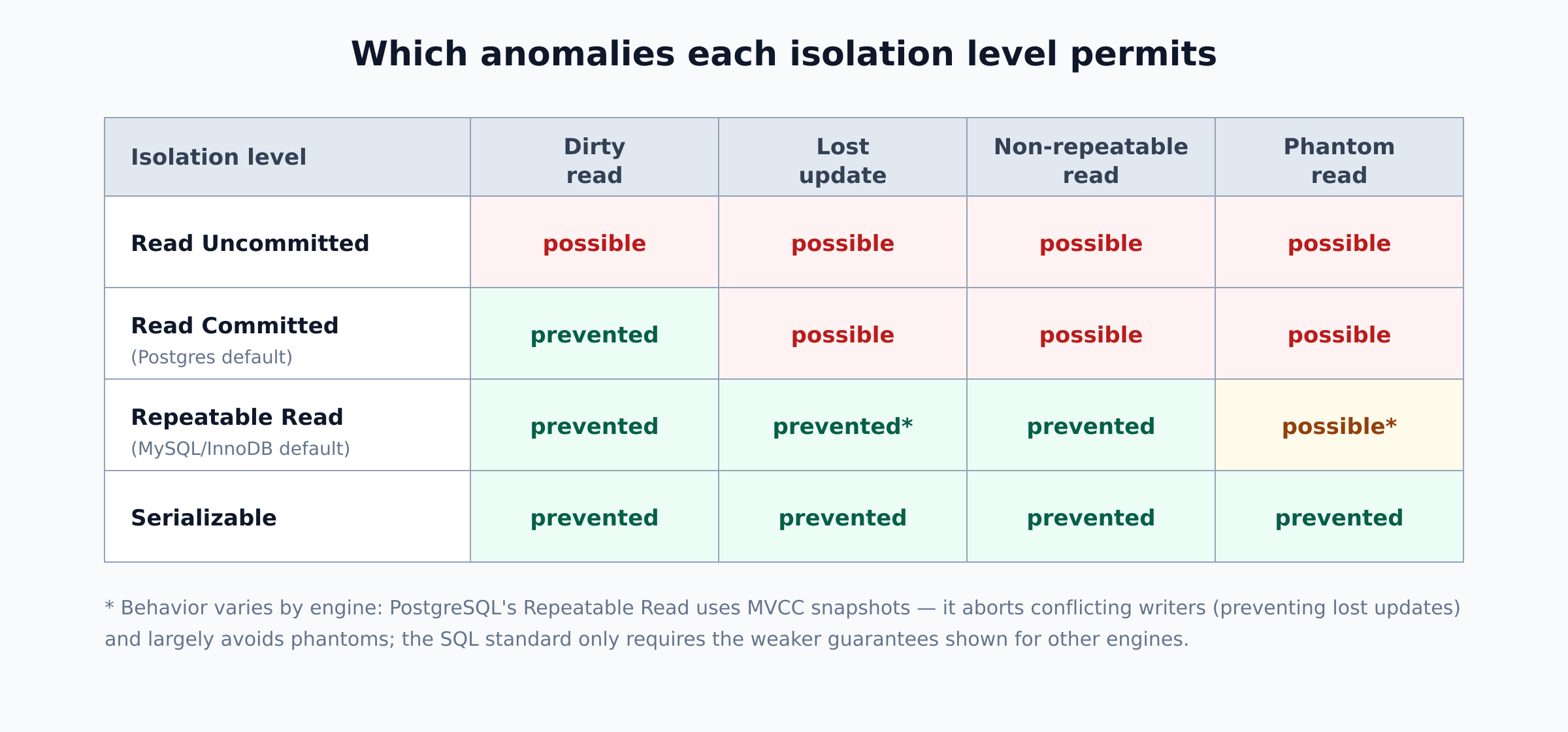
- Read Uncommitted — transactions can see other transactions' uncommitted writes. Everything can go wrong. PostgreSQL doesn't even really implement it: ask for it and you get Read Committed.
- Read Committed — you only ever see committed data, so no dirty reads. But each statement gets a fresh snapshot, so non-repeatable reads, phantoms, and lost updates are all still possible. This is PostgreSQL's default.
- Repeatable Read — the transaction takes one snapshot and every read within it sees that snapshot. No dirty or non-repeatable reads. In PostgreSQL, a concurrent write to a row you've also written aborts one transaction with a serialization error rather than losing an update. The SQL standard still permits phantoms at this level (engines vary — Postgres's snapshot largely avoids them, MySQL's InnoDB uses gap locks).
- Serializable — the result is guaranteed equivalent to some serial order. All four anomalies prevented. In PostgreSQL this is Serializable Snapshot Isolation: instead of blocking, it detects dangerous patterns and aborts one transaction, which your code must retry.
The key mental shift: the default isn't "safe". If you've never set an isolation level, you're on Read Committed (Postgres) or Repeatable Read (MySQL), and the lost-update scenario from Part 1 — two purchases both reading stock = 10 — happens exactly as described.
How the database pulls this off: MVCC
PostgreSQL doesn't implement isolation by making readers wait for writers. Under MVCC — Multi-Version Concurrency Control — every write creates a new version of the row, and every transaction reads the version that was current as of its snapshot. Readers never block writers; writers never block readers. Two writers to the same row still conflict — that's where row locks and serialization errors come in — but the common read-heavy workload flows without contention.
This is why "just use Serializable everywhere" isn't free: the database has to track read/write dependencies between transactions and abort those that would violate serial order. On a hot row — the last copy of a popular book — abort-and-retry rates climb fast.
Setting the isolation level from Python
With SQLAlchemy:
from sqlalchemy import create_engine

# engine-wide default
engine = create_engine(DATABASE_URL, isolation_level="SERIALIZABLE")

# or per-connection, for just the endpoints that need it
with engine.connect().execution_options(
    isolation_level="SERIALIZABLE"
) as conn:
    with conn.begin():
        ...
With asyncpg, set it when opening the transaction:
async with pool.acquire() as conn:
    async with conn.transaction(isolation="serializable"):
        stock = await conn.fetchval(
            "select stock from books where id = $1", book_id
        )
        ...
With Django, the level is configured per database in settings.py (OPTIONS: {"isolation_level": ...} for PostgreSQL via psycopg); transactions themselves are transaction.atomic() blocks.
And the part that's easy to forget — Serializable and Repeatable Read abort transactions under contention, and you must retry:
import asyncpg

async def buy_book_with_retry(pool, book_id, max_attempts=3):
    for attempt in range(max_attempts):
        try:
            async with pool.acquire() as conn:
                async with conn.transaction(isolation="serializable"):
                    return await do_purchase(conn, book_id)
        except asyncpg.SerializationError:
            if attempt == max_attempts - 1:
                raise
            # brief backoff, then re-run the WHOLE transaction
The retry must re-execute the entire transaction from the top — re-reading stock included — not just replay the final write. If your purchase flow has side effects (emails, payment calls), they need to live outside the retried block, which is a preview of Part 3's territory.
Choosing a level in practice
- Read Committed + explicit locking or atomic updates is the workhorse. You handle the hot paths (inventory, balances) with row locks or single-statement updates, and everything else enjoys high throughput. This is what Part 3 is about.
- Repeatable Read fits multi-read consistency: reports, exports, anything that reads several times and needs one coherent snapshot.
- Serializable fits invariants you can't express as a row lock or constraint — especially set-level rules where phantoms bite ("max 5 open orders"). Budget for retries.
- Read Uncommitted — no. Postgres won't give it to you anyway.
Summary
Four anomalies — dirty reads, lost updates, non-repeatable reads, phantom reads — and four levels that progressively eliminate them, paid for in throughput and retry logic. The pragmatic production posture is usually not cranking isolation to maximum: it's staying on Read Committed and protecting the few genuinely contended rows explicitly.
How to do that — SELECT ... FOR UPDATE, optimistic version columns, and atomic conditional updates — is Part 3.