From Documents to Answers: Building a Full RAG Pipeline with Chunking and an LLM
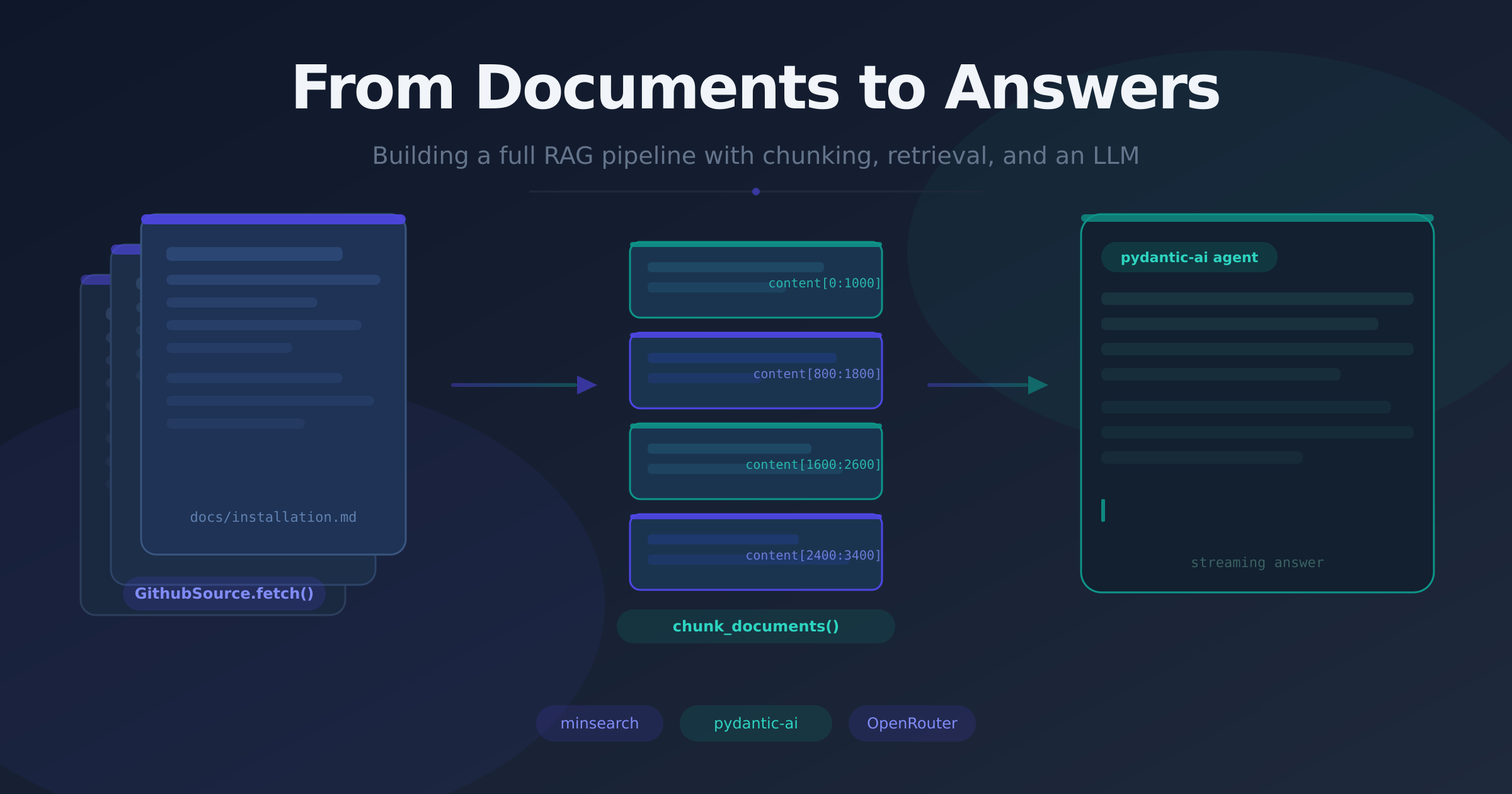
Retrieval, chunking, and generation each get their own tutorials. Wiring them together into something you can actually run against a real repository is where the interesting decisions happen. This post walks through how chunk_documents(), a minsearch index, and a pydantic-ai agent connect into one pipeline that answers questions about any GitHub repo's documentation.
The problem: whole documents make poor context
The project could already search documents — GithubSource fetched markdown files from a GitHub repo and minsearch scored them against a query. But the unit of retrieval was the entire document. A 4,000-word setup guide came back as a single blob.
That fails in two directions. Fed to an LLM, a long document buries the relevant paragraph in noise and consumes context window budget fast. Shown to a user, it's a wall of text to wade through. Neither is an answer.
The second gap was generation itself. Retrieval existed; synthesis didn't. You could find documents, but nothing composed a reply from them.
The approach: overlap at the seams, an agent for answers
Two changes: chunk before indexing, and add a pydantic-ai agent for generation.
Chunking lives on GithubSource as a method rather than a separate preprocessor, which keeps the call site clean:
documents = github.fetch()
chunks    = github.chunk_documents(documents)
index     = build_index(chunks)
The alternative — a standalone Chunker class — would have added a layer of indirection without adding clarity at this stage. The document-loading abstraction already owns everything about how docs are fetched and shaped; chunking is a natural extension of that responsibility.
For generation, pydantic-ai connects to an LLM through OpenRouter. The streaming interface (agent.run_stream) shows answers token by token — the right feel when a response takes several seconds. Using the free tier keeps the pipeline zero-cost during iteration.
A vector store with embeddings would catch more semantic similarity, but it adds an embedding model, a vector database, and network latency. minsearch's TF-IDF approach is the correct trade-off here: in-process, zero-infrastructure, and fast enough for interactive use.
Implementation highlights
Chunking with overlap
A sliding window with chunk_size=1000 and overlap=200 gives an 800-character stride. Without overlap, a sentence that crosses a chunk boundary gets split and scores poorly against any query targeting that sentence. Overlap ensures boundary text lands fully inside at least one chunk.
def chunk_documents(self, documents, chunk_size=1000, overlap=200):
    for doc in documents:
        content = doc["content"]
        for i in range(0, len(content), chunk_size - overlap):
            chunk = content[i : i + chunk_size]
            chunks.append({
                "content": chunk,
                "title": doc["title"],
                "description": doc["description"],
                "file_name": doc["file_name"],
            })
Each chunk inherits the parent document's title, description, and file_name. That metadata travels through the index and comes back with search results — how format_context() can cite source files in the LLM prompt without a second lookup.
Known bug: The current diff iterates over
range(0, len(doc), ...)— the dict length (always 4), not the content string — and slices to1+chunk_sizeinstead ofi+chunk_size. So every document currently produces four identical copies of its first 1,000 characters. The fix isrange(0, len(content), chunk_size - overlap)andcontent[i : i+chunk_size].
Text fields vs. keyword fields
index = Index(
    text_fields=["title", "description", "content"],
    keyword_fields=["file_name"],
)
index.fit(chunks)
Keeping file_name as a keyword field keeps it out of BM25 relevance scoring. It's for exact-match filtering ("only search docs under docs/reference/"), not semantic matching. At query time, boost_dict={"content": 1.5} nudges the scorer to weight the passage text more than the title, which sharpens precision for prose questions.
A domain-agnostic system prompt
Instead of hardcoding "you are a documentation assistant for Evidently," the SYSTEM_PROMPT tells the agent to answer about "whatever documentation is supplied at runtime." Swap GITHUB_URL to a different repo and the agent adapts with no prompt change.
Three behavioral contracts are spelled out explicitly: grounding (no claim without supporting context), self-correction (infer intent → select relevant passages → reconcile conflicts → re-check draft), and session learning (treat corrections as durable signal across turns).
Attribution for free
def format_context(results):
    blocks = []
    for doc in results:
        blocks.append(
            f"Source: {doc['file_name']}\n"
            f"Title:  {doc['title']}\n"
            f"{doc['content']}"
        )
    return "\n\n---\n\n".join(blocks)
Labeling each block with its source file lets the model cite files in its answer — no post-processing. The --- separators read as section boundaries to most models.
The pipeline
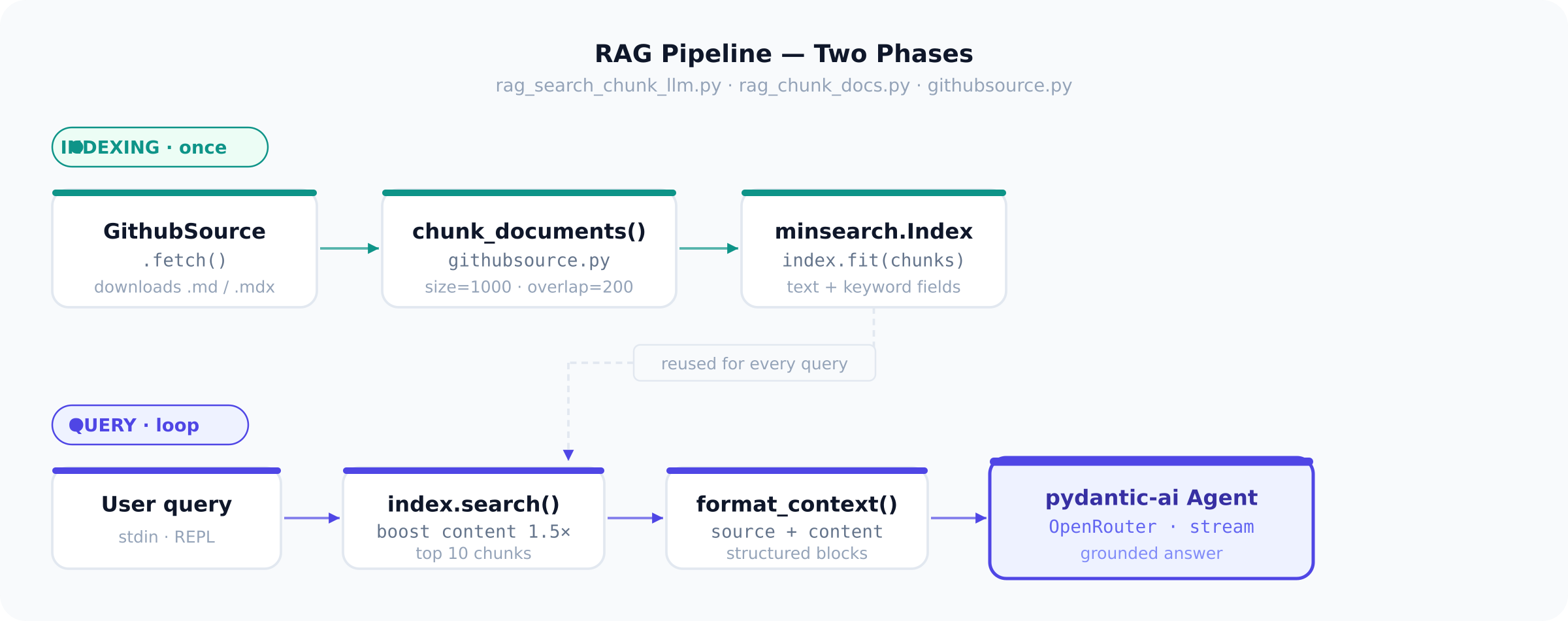
The index is built once at startup and reused for every query in the session. Building it per question would re-download and re-chunk the whole repo each time — expensive and unnecessary. The query loop is: user input → index.search() → format_context() → build_prompt() → streaming LLM response.
The streaming loop is worth a look:
async with agent.run_stream(prompt) as result:
    async for chunk in result.stream_text(delta=True):
        print(chunk, end="", flush=True)
flush=True is what keeps the terminal responsive. Without it, the answer buffers and appears all at once after a delay — which feels slow and broken for a long generation.
What shipped
Three new capabilities from three files: githubsource.py gets chunked document splitting, rag_chunk_docs.py provides a retrieval-only harness for debugging the index without spending an LLM call, and rag_search_chunk_llm.py is the end-to-end demo you can point at any public GitHub repo by changing GITHUB_URL.
What's next
Fix the chunking loop first. The stride and slice bugs mean the pipeline runs but produces garbage chunks. Nothing else improves until these two lines are corrected.
Thread message history. The query loop discards context between turns. Passing message_history into run_stream() — already done in llm.py — makes the self-learning system prompt behaviorally meaningful for multi-turn sessions.
Sentence-aware splitting. Character boundaries cut mid-sentence. Splitting on paragraph breaks (\n\n) or sentence endings would produce semantically cleaner chunks and better retrieval precision on prose documentation.
Persist the index. Re-fetching and re-chunking the repo on every startup is slow. Serializing the fitted index to disk makes repeat queries near-instant for interactive use.
Retrieval visibility. There is no way to know whether the top-10 chunks are the right ones. Logging which files surface per query is the minimum needed to tune boost_dict and num_results with actual evidence.